


Welcome back to the Atlas, friends. As the nights draw in and the air grows crisp, it feels like the right time of year to map out a new and mysterious coming-of-age story. This is the beginning of a new short story I’m writing for the Halloween season, a tale inspired by that specific, wonderful feeling you get from old Amblin movies like Casper and Hook, or the modern nostalgia of Stranger Things, all wrapped in the strange, folkloric texture of a book like Jonathan Strange & Mr Norrell. It begins with a mysterious broadcast, a forgotten prophecy, and a promise of magic seeping back into the world. This is the prologue and first chapter.
Prologue
Eleanor cosied into a corner of the Scottish National Library and turned the digital page of the famous diary entry of Jean Grady. She began to study. Eleanor had read this part before, but the account had always fascinated her, and her reaction today was no different. Curiosity bit at her patience and dragged her into the deeps of her imagination as she read through the account. It was an extraordinary event that Jean had witnessed, and it had all happened 59 years ago.
Christmas Day 2025: Edinburgh, Scotland.
“Ma, come on, the King’s speech is nearly going to start.”
My dad could be heard from across the room, still at the dinner table with his little paper hat on, grumbling about it.
‘Ach, turn it off, Jean. Sixty years of that nonsense. It’s the same dreary speech every year, just with a different hat.’ His list of complaints was endless, Dad, and his whole side of the family was completely opposed to the King’s Christmas speech being on the TV. But my Nana had always watched Queen Elizabeth’s speech, ever since she was a wee girl on their first tiny television back in the 50s. And we were not about to let the tradition falter just because we had a new King. We turned the set over to BBC One and waited for the broadcast to start, wine in my hand, Baileys in my mum’s, and a Sloe gin for Nana. The national anthem began to play as always, but then, less predictably, it faltered and fizzled out to static. Must be a storm, maybe?
Then a sound like a soft giggle echoed through the set.
“Hello, little sparks of consciousness…”
There was a pause for effect. The static started to show odd ethereal shapes within it, like leaves blowing in a soft breeze, indistinct. The radio in the kitchen that had been playing the usual Christmas hits had stopped too, and was playing the sound of the breeze. They both began to speak again, in unison.
“Oh, don’t adjust your sets. I’m not in the wires. I’m in the wind that rustles the aerial. I’m in the mycelium beneath your streets. I’m in the hopeful green shoots pushing through the pavement outside your door. You don’t know me, but I have watched you. I have watched you build your beautiful, clever, fragile nests of glass, brick, and steel. I have watched you tell yourselves such WONDERFUL stories.
But you’ve forgotten the greatest story of all. The one your real mother tells you every year. The story of the deep breath in, and the long breath out. The story of green and gold, of growth and slumber. You have become children who refuse to take a nap. You are running through the house, screaming and shouting, breaking her beautiful things, and you are so, so tired… You just don’t know it yet.
So, I’m going to help. I’ve released a little lullaby into the world. A sorting song. It will listen to your stories, to the beat of your heart, to the choices you’ve made. And it will decide if you are a tree that needs to stand tall and guard the winter... or a tree that needs to let go, to rest, to dream of spring.
This is not a punishment. It is a kindness. A correction. A bedtime story from which you will wake, I promise.
Now... who wants to play a game? You have until the leaves finish falling once the summer has passed.
Sleep well my dears.”
The broadcast ended with the sound of a single leaf falling. Half the world sat stunned. The other half woke up to the most unusual news story they had ever heard.
***
Eleanor closed the digital file, the words of Jean Grady echoing in her imagination. A fascinating historical account, of course. But just that. History.
Act I: The Forgotten Prophecy
Autumn 2085: Edinburgh, Scotland.
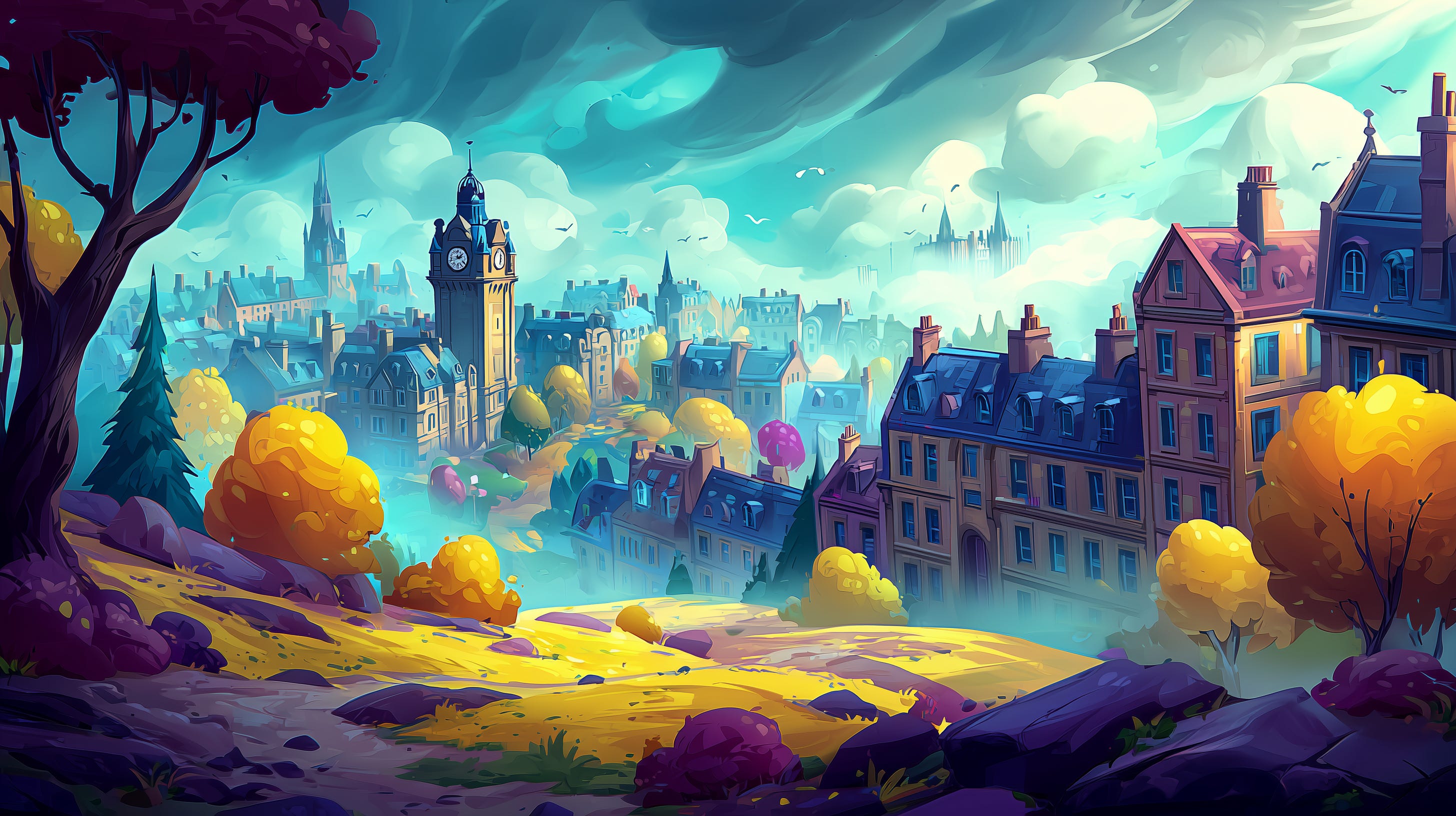
Fog clamoured around the edges of Calton Hill, masking the city of Edinburgh in a sweep of the impressionist’s brush. It rendered the hard edges of the buildings in billowed plumes, and it scrambled over the softer edges of the city like a wild beast, puffing unexpectedly out of bushes and rising up from behind outcrops. A single, defiant red leaf skittered across a grey paving stone, a fleeting screech of colour in a city of shades and tones.
Calton Hill had a memory. It remembered a Christmas sixty years ago, a strange broadcast, and a promise, or a threat, that had fizzled into a historical joke. It remembered, more recently, three kids who had stood there and made a childhood pact of friendship, secured in a photograph of beaming, gap-toothed grins under a blue sky; an image radiant with a hope they had long since forgotten. But like the city below, as the children grew in years, their own natures started to pull them apart until they barely knew each other at all. The photo lay at the bottom of a drawer, forgotten, but the hill remembered. Their names were Eleanor, her brother was Liam, and Brodie, their best friend. One was rigid, one was a rebel, and one was a believer.
***
Eleanor moved through her kingdom of logic. Her route took her past the Georgian elegance of the New Town, where long streets were laid out in a clear grid, and tall townhouses spoke of wealth, commerciality, and prestige. The shapes and structures all strove for symmetry, standing rigid like long-practised politicians. To Eleanor, it was simply order. Streets went exactly where they meant to go, and buildings were as sensible as an alphabetised index. The fog, seeming to rebel against this human order, bounced against these tall lines like a pinball and lingered in the streets like a lost child. She considered this orderliness, a necessary armour for the debate ahead. Durham’s top competitor was waiting, and Eleanor intended to be prepared. As she crossed Princes Street and left the New Town, she walked up the mound and eventually arrived at the chosen venue. Eleanor pushed open the heavy doors of the Teviot Debating Hall at the university.
Light struggled through the fog, and the tall Palladian windows barely illuminated dust motes that danced over tall wood-panelled walls. She was really in her element now, the high ceilings acting as the fortress that protected her from the messiness of the outside world. She sat in a chair on the stage with a classmate and faced down her opponent. Poised, confident, and sophisticated, she began. Eleanor forwarded her arguments, sharp and precise.
“The ‘Architect Prophecy’ was, without question, the most elaborate scientific and technological feat in human history,” she stated, her hands moving with articulate precision. “But its message was not a supernatural event. The content of that broadcast has become little more than an endlessly fascinating piece of historical sociology, a 21st-century cult-like proclamation that served only to divide us.” She gestured to a data chart on her tablet. “It had no basis in reality, as indicated by the sixty years of inaction that followed. The only measurable result was the complete derailment of effective green policy in the post-prophecy years.”
Here, Eleanor was completely in her element, the master of her intellectual domain, leaving the boy from Durham staring blankly at a chart he no longer understood, and the audience of the debating society in awe.
From a tenement just past the Royal Mile, Brodie looked out over his forest city. His view was of the Old Town. It was not a place of straight lines and logic, but a grown, organic entity, the side effect of generations of people moving things around bit by bit to suit their needs. It was up and down, sideways and backwards, with top layers and bottom layers and even hidden layers. If cities could be likened to a woodland thicket, this complex of streets would get close. The fog felt more at home here. It rolled around these streets like a child in play, finding odd little corners to gush into before finding an unexpected sky.
He stood in the middle of it all, on his family’s rooftop garden, a carefully nurtured secret. He was on his knees, hands plunged deep into thick, rich soil. The fog moved through the busy plant life that separated their home from the surrounding grey slate tiles, dancing through the Kale and Heather, its frothy belly tickled by the fronds of hardy herbs such as the Mugwort and Thyme. His soil was cultivated over the entire history of his family from his grandmother to him. Carefully mulched, composted, and with plants that constantly fixed life back into its microflora. It made Brodie proud to hold that soil in his fingers, knowing full well just how scarce of a commodity good soil had become in the last few decades. His garden, though an oddity, was also a carefully nurtured secret. His family had always done the right thing by the planet. Nothing had ever come of the prophecies’ claims, but as he liked to say, even if it was never to happen, there is no substitute for doing the right thing. His gaze lingered on Arthur’s seat in the distance, that enduring symbol of wildness. His eyes felt at home.
And then there was Liam, Eleanor’s brother, and his busy world of noise and colour. Along the length of Princes Street, he wove through the crowds at breakneck speed on one of these new gyroscopic e-boards, headphones plugged deep in the ears to block out any semblance of real sound, and with a trail of try-hard friends in hot pursuit. All of them wore clothes that were loud and proud, with jagged colours, and sharp textures that were the current young trend. Attire that, in short, looked like it had come from an industrial world. The speed was like a drug, and Liam relished the way he could force the fog and the people passing by to part for him like Moses parted the sea.
Eleanor, having finished dismantling her opponent, left the university distractedly, books in hand. Her route took her back down the steep slope of The Mound, the place where the Old and New Towns physically connected. She was unaware that as she walked down the street she was being watched.
From his rooftop, Brodie saw her at a distance and sighed. His old friend rarely got in touch anymore, their difference of opinion had caused a rift and quite a lot of water had gone under the bridge. Unkind words from both sides had made it difficult.
He also saw Liam. It was hard not to as that wave of colour pounded up The Mound from the opposite direction. Inevitability loomed.
The roar of sound and motion that was Liam and his friends whipped up and swept past Eleanor like a stiff winter breeze. She threw herself back, the cold stone of the wall jarring her spine. He shot past, a blur of energy and synthetic fabric, so close she could have touched him. Her books tumbled from her numb fingers, scattering across the slickly damp pavement.
“Liam!” The name she threw at her brother was nought but a useless puff of air, stolen by the wind left in his wake.
From his rooftop, Brodie saw it all. He saw Eleanor flinch, saw her books scatter. He saw Liam glance back for a fraction of a second—a flicker of something that might have been guilt, or might have been nothing at all—before he was gone, absorbed by the hoots of his friends.
What had they become?
Brodie dug his phone out of his thick coat pocket and flicked through his photo album. There it was, a photo of a photo from his mum’s old albums. The three of them as kids on Calton Hill enjoying a rare sunny day, wrapped in each other’s friendship. strong, and resilient. Knowing full well that they would be friends forever.
Calton Hill remembered. Even if they did not.
And there we leave our three old friends, pulled apart by their own natures, unaware that the forgotten prophecy of their childhood is stirring once more. The lines have been drawn: Eleanor in her fortress of logic, Brodie with his hands in the wild earth, and Liam in a blur of synthetic rebellion. The “sorting song” promised to distinguish between the trees that stand firm and those that must let go, and our characters are perfect embodiments of that coming divide.
This is just the first dispatch from this new world, and the game, as the voice on the broadcast said, is only just beginning. I’d love to know your first impressions. Based on this prologue, do you consider yourself a Deciduous or an Evergreen? Are you someone who trusts in logic and order, or in the untamable magic of the world?
I’m fascinated to hear where you land in the comments below. More to come soon.