


Welcome back to the Atlas.
This is the second entry in our ongoing series, Raw & Unedited, where we look inside the engine room of the creative process. I have mentioned before that I write two pages of my story, ‘the strings of us’, in my notebook every day, stream of consciousness. This is the result of that.
Last time, we met the old mentor, Jun'ip, as he reflected on his brilliant but troubled student, Cash'ya. Today, we join their conversation as Jun'ip attempts to soothe Cash'ya's distress not with logic, but with a story, a foundational myth from the rabbit archives with a surprisingly dark twist. Let's dive in.
Italicized Text: Passages I'm reflecting on.
Author's Note: My real-time editorial thoughts and plans for the next draft.
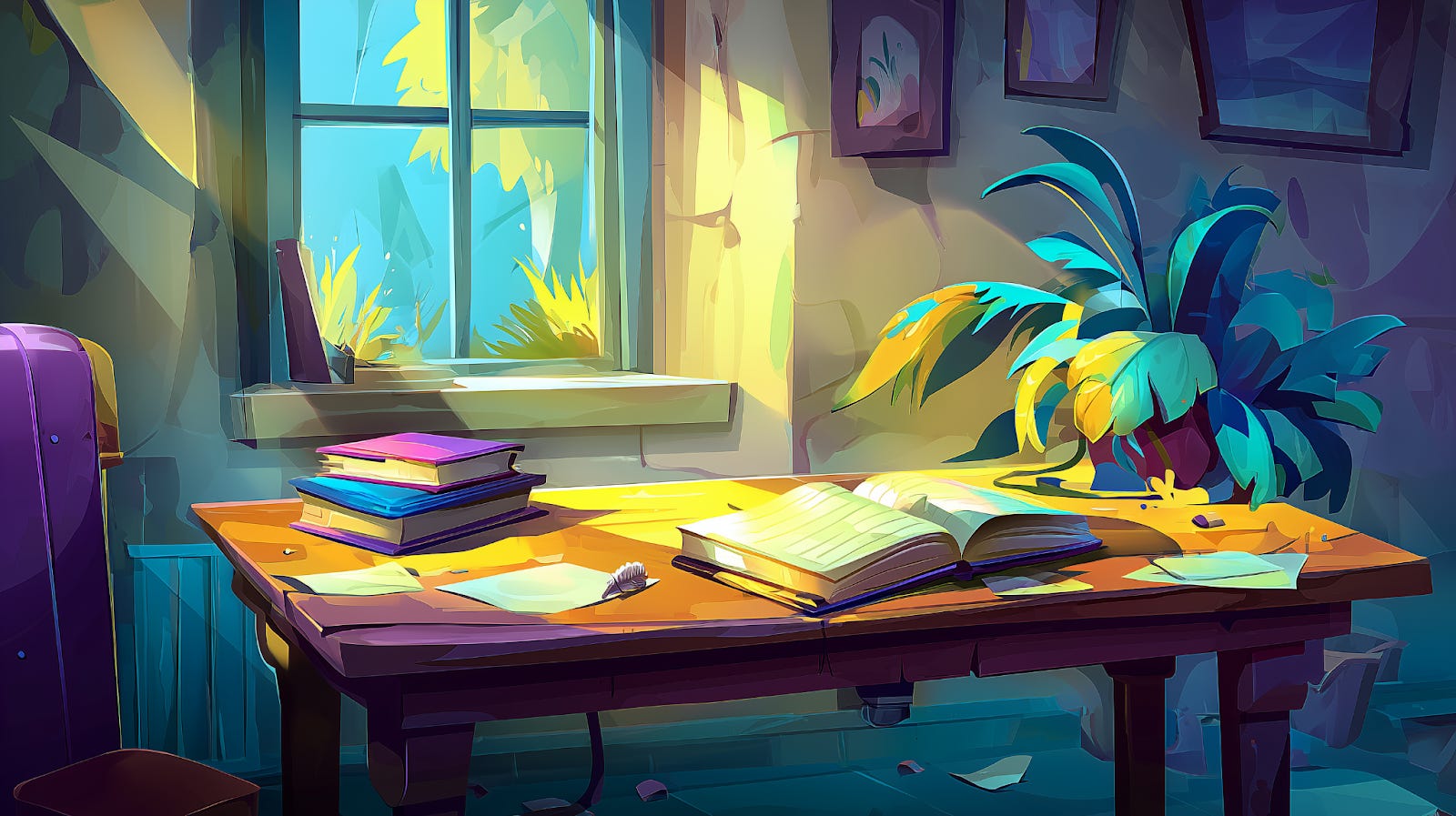
The story continues…
Cash'ya's voice became the entirety of my focus again, and her string continued its slightly discordant hum.
"You are circling the same point my dear," I said gently. "Your frustration, can you pin point it for me please, rather than walking around it?"
She looked at me a bit sharply, as if to reproach the direct question, but my gentle smile softened her eyes and she bowed her head slightly.
"Elias," she muttered, her ears twitching with frustration. She looked about herself as if searching for something, a distraction, or maybe a solution to the magma buildup she could feel surging up inside of her.
"GAH! Frustration doesn't even cover it, it's despair! How am I to compile a unified history - our truth - alongside a man who believes truth is just an aggregate of verifiable facts? He reads and listens to our stories and sees only metaphor and myth! It's just the way humans are. All logic and no feeling!” Cash’ya’s disdain was palpable.
“I mean, come on, he patted my head at the meeting, literally and figuratively." Cash'ya squirmed at the thought of it.
Author's Note: Cash'ya's anger here is aimed at Elias, but this is only the surface itch. The real, deeper fear is self-involved. She isn't truly afraid of Elias, but of what he represents: a challenge to the core values that have formed her ego. Her identity and her reputation among her peers are built on a specific worldview, and Elias's fact-based approach threatens to dismantle it.
Editing Plan: To show Jun'ip's observational skill, I'll add a specific physical 'tell' that he notices. As she speaks, he'll observe that her gaze shifts in a very particular, human-like way, looking in one direction when stating her frustration (the truth), but looking in another when trying to justify it (the insecurity). This grounds his intuition in observable details and reinforces her "human-like" internal conflict by displaying a very human tell.
I sensed then that this was only the surface itch. She had a lot more going on underneath. I decided to play along for a bit.
"He has also held up your work for all to see," I countered. "His first book... The Rabbit Awakening. A human trying to understand our origin."
"Exactly!" she retorted. "He studied it, he didn't feel it. He wrote about Que'rup’s awakening as a sociological phenomenon, not the moment the universe first SANG to one of us. He will do the same to the root of our history as well. How can I work with that?"
I decided to ignore the question. My job was to help Cash'ya emotionally, not pragmatically. She would be quite capable of figuring that conundrum out on her own. No, I needed to scratch deeper. I placed a gentle paw on her shoulder, stopping her mid stride.
"Hush now for a moment my dear, breathe. Your string is singing such a frantic song, I can barely hear your words over its noise. Let's for a moment be rabbits again. Thinking will only get us so far, let's listen. Let me tell you a story... but first, settle down and attune to your own heart string."
Cash'ya stopped sully. We both hopped over to a window seat. It would have been a nice spot, adorned with potted plants and a stunning view over the moon below. But Cash’ya could barely notice. I breathed a deep consoling breath which she followed, and then slowly she closed her eyes. I started sensing her string, I felt it tighten its pitch a little as she began to smother it with her awareness. She began to see how fraught and tense it had become during the conversation about Elias.
I started the story.
"Let me tell you the tale of 'Whisper-in-the-grass'," I said softly, my voice taking on a storyteller’s cadence.
Author's Note: This is the introduction of a "story-within-a-story," a classic narrative device. It's a powerful way to teach a lesson or provide crucial backstory without a simple exposition dump.
Editing Plan: My pacing strategy here is to mirror a reader's own process of immersion. At the beginning of Whisper's tale, I'll cut back to Jun'ip and Cash'ya more frequently. To guage this pacing I will literally read the story aloud and find the moment I, the author, feel "hooked." Cash'ya's reactions, a physical relaxing, an ear twitching, a softening of her string's "song"—will mirror that journey from detached listener to immersed participant.
"Whisper was a quiet mother of three, living in northern Europe, back when humans were still transitioning from their hunter gatherer society roots to an agricultural system. Whisper did not know this, of course, her life had been simple and she had never encountered a human in her life. For as long as she could remember, her world, a large meadowland that decorated the edge of a wide river, was her home. She had spent many carefree seasons there among the flowers, frolicking through the tall grass, and playing games over the river with her ‘skill’."
My own heart string began to play along to the rhythm of the story, its slow gentle cadence, roll, and bounce, rippling out into the world along its length. Little sprinkles of merriment tumbled into that warming backdrop of musical vibration, eliciting memories of flower scents and clear blue skies. As my ripples spread, I slowly felt Cash'yas string subtly respond. Like a jazz musician whose ears might have caught a sound on the breeze, a melody calling to it, an invite to join in.
Author's Note: This scene, where Jun'ip's "heart string" plays a song, is a key piece of world-building. The "strings" are not a magical power, but a rabbit's intuitive perception of the universe's interconnectedness, like ripples in a pond. Jun'ip, being a master, can create a powerful, calming "song" with his own string, and as the ripples overlap, Cash'ya's frantic string naturally begins to synchronize with his.
Editing Plan: While the "music" metaphor is strong here, the larger plan is to explore this system from multiple perspectives throughout the book. Later drafts will include scenes where this phenomenon is debated by characters, explored objectively as a science, and felt subjectively by others. This ensures the world-building feels robust and integrated into the story's core philosophical questions.
“Of course, Whispers world would not remain peaceful forever. Any life, long or short, will experience its own ups and downs, and Whispers was no exception... There came a day when she met humans for the first time…”
The song my string was playing became melancholy... and it began to pluck out the melody of fear, of foreboding.
“Humans at this point were still hunter gatherers... Whispers first awareness of them came in the form of a strange scent on the breeze as her cousin's body was cooked over a flame and consumed. It nearly made her sick with both grief and a physical revulsion that was hard to swallow.” Over the next year, Whisper witnessed first hand the disregard these humans had for the sanctity of their lives. They had something us rabbits had never come across before. They had tools, deadly traps, and weapons.”
Author's Note: This is a deliberate and abrupt tonal shift. It’s the first time the book reveals the dark, predatory history between humans and rabbits, moving the story from pure whimsy into a deeper reflection on the moral complexities of real-world history.
Editing Plan: To heighten this moment in my next edit, I will use a cinematic "zoom in" with prose. The sentences leading up to the reveal will be longer and more flowing (a "macro" view). The moment of the reveal itself will use short, sharp, sensory-focused fragments ("A strange scent. Cooked meat. Grief.") to create a visceral shock. Immediately following, I will cut back to Cash'ya in the frame of the story, describing her physically flinching, mirroring the reader's own jolt of horror. This shared experience validates the reader's reaction and deepens their bond with her.
The song of my string became sorrowful, painful. I could see Cash'ya was gently shivering. Her string now in perfect harmony with mine was feeling the emotions of the story just as I did.
And this is where my stream of consciousness writing ends, for now.
I always find it interesting reading back over my first utterings. I often feel as though I am not a natural writer, but I love storytelling. In the same way that you might not be a natural singer, but you love to write songs.
Still, this is a process, and like all processes, there will be refinement and progress over time.
In this section, I focus on a core trope, the mentor. A mentor's story can be a powerful tool. It isn't just about imparting information; it's about creating a shared emotional experience that can bypass intellectual defenses and speak directly to the heart. It's a way to teach a lesson not by explaining it, but by making someone feel its truth.
What do you think?
How about you? Do you like this style of storytelling? What is a memorable example of a "story-within-a-story" from a book or film that has stuck with you? I'd love to hear about it in the comments.