


Why the foundations of good cookery are the secret ingredients to writing a story your readers can’t put down.
Growing up, I was fortunate to have a mum who was a chef. She had worked many different cooking jobs and picked up a lot of skills through her career. Initially it was wasted on me, (I was a very fussy child and couldn’t see my way to eating anything that was actually good for me), but as I got to university age, the need to learn some cooking skills quickly became apparent. I started as a deeply chaotic wannabe, much like the Swedish Chef in the muppets. But with each subsequent visit back home, I set about learning something new, and to my surprise, it was never a lesson related to ingredients or flavour. Rather, the basic value of everything I was taught could be linked back to the intrinsic foundational elements of good cookery.
Sadly for my mum, someone else managed to write the book on this first, before she had a chance to put pen to paper. Samin Nosrat’s ‘Salt, Fat, Acid, Heat’ is that book, and it is truly excellent at explaining what these elements of good cookery are. But I maintain that my mum was the real trend-setter.
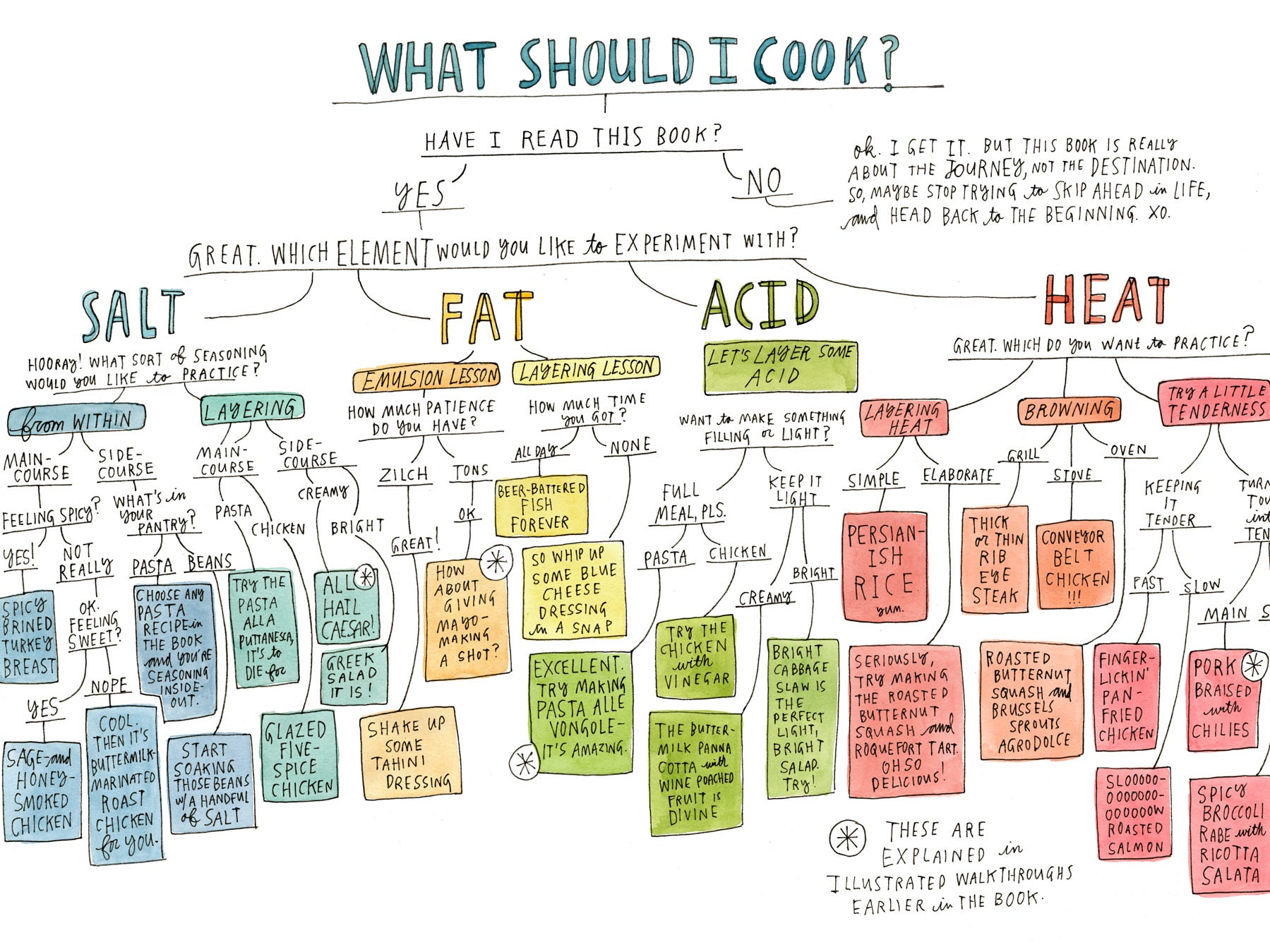
The basic premise of this book and these lessons is simple. There are a few basic levers in cookery which, when pushed or pulled, will take what you are cooking from bland to exciting, from stilted to balanced, and from flavourless to flavourful. I believe these levers exist for writing too, and it is my intention here to point them out and show you how to manipulate them yourself, all through the ongoing metaphor of cookery.
Just as a chef uses these elements to turn raw ingredients into a masterpiece, a writer can use them to turn a sequence of events into a compelling narrative.
Salt - A.K.A - Stakes and Conflict
Salt doesn’t necessarily make food salty, unless you add far too much. It enhances flavours that are already there. You can almost think of it as a volume dial and a clarity enhancer for food. Strangely, the science is quite counter-intuitive. Salt actually knocks back our bitterness receptors, allowing other flavour receptors to be more prominent. Alongside that, salt extracts water from the ingredient, releasing volatile aroma compounds which account for 80% of what we taste through our smell receptors.
In short, it is rather a useful little ingredient. But it must come with a warning. Too much, and food will taste grotesque, like swallowing seawater. Too little, and the food will be bland, like chewing paper.
The salt of storytelling is how you apply stakes and conflict in your narrative. Now, stakes and conflict don’t necessarily change who your character is, but they will bring their true nature to the surface, just as salt brings the flavour of an ingredient to the fore. Without stakes and conflict, a scene is bland. Just two people talking in a room about nothing much. But if you add a deadline, a secret, a threat, a hierarchy, or any number of other things. Suddenly things get interesting.
“Marjorie, I do not wish to alarm you, but for the last few minutes your tea cosy has been ticking.”
Of course, like salt, stakes and conflict have to be judiciously used. Too little and the story becomes slow and bland, but too much, where every moment is a crazy life-and-death situation, it becomes exhausting melodrama that will put most people off. Balance is key.
Salty lessons from ‘Deciduous and Evergreen’.
In my work-in-progress novella, ‘Deciduous and Evergreen’, there is a clear set of stakes that slowly apply pressure to my characters all the way through. That pressure is the countdown clock from the architect’s broadcasts, as he announces increasingly scary layers of retribution for acts against nature.
This global pressure, as stranger and stranger phenomena occur, forces the characters to reveal their true natures: Elara retreats into logic and data, Kael leans into his community’s faith, and Liam spirals into hedonistic rebellion. The stakes make their internal flaws visible, and it is this that instigates their character growth from flawed to (hopefully) better people.

Heat - A.K.A - Plot.
Welcome to the furnace. Mwahaha! Heat is the great transmuter, and applying heat to your raw ingredients forces a chemical change that produces flavour, texture and all sorts of other fun reactions. It is the element that takes your basic components and turns them into something new; it forces change.
In storytelling, heat is the crucible of the plot. It is the inciting incidents and escalating actions that force a fundamental alteration.
You might easily mistake plot for stakes, or heat for salt to use this metaphor. But they serve different purposes. The salt (stakes) don’t actually change the ingredients. They just bring their best nature to the fore. The heat is the breakdown of the ingredients and their birth into something new. To put it simply, you can’t unbake a cake.
So, while the stakes make them react, the heat of the plot is what breaks down their old worldview and forces them to adapt, learn, and permanently change in order to survive. This is your character arc.
What kinds of heat can you apply in a story?
Heat consists of the structural plot beats that systematically dismantle your characters’ old worldviews and force them to adapt. You can apply heat through threshold crossings that strip away their comforts, like dropping raw ingredients into a hot pan, or through crushing failures that show up the characters’ inadequacies. Heat is the shocking betrayals that destroy trust, the losses of their allies that force them to step up and be responsible, or even a ‘dark night of the soul’ moment where they must sit with their journey so far and realign their compass.
These elements aren’t just threats hanging over your characters’ collective heads; they are friction points that permanently cook them into new versions of themselves.
How the plot heats up in ‘Deciduous and Evergreen.’
One moment of heat happens for Elara, who starts off as a ‘know-it-all’ researcher who has an agenda. She engages the world in a broadcast that seemingly casts aside any likelihood that the architects’ threats of supernatural retribution are anything other than a cruel prank. Unfortunately, she wakes up just a day after her greatest achievement, immediately humbled by the first of the prophecies coming true. It is this humbling that causes her to finally leave the sanctuary of her held beliefs and seek out her old friend Kael for help.
Fat - A.K.A - Emotion and Interiority
Fat in cooking, such as butter, olive oil, ghee, is an essential component of your dishes, unless you want to have exceedingly flavourless food. It was once demonised as the ultimate threat to people’s health in their diets, but it has subsequently been shown to be pretty essential to health, and very essential to flavour.
To put it succinctly, fat carries flavour. Imagine a person at a water park in a giant rubber ring going around a water rapids. The person is flavour, the rubber ring is fat. Many aroma compounds are fat-soluble; think things like the aroma of garlic or rosemary. They will literally meld with the fats, coating the palate and allowing the flavours to linger and feel satisfying.
In your stories, character interiority and emotional resonance act as the fat in your dish. You can have a brilliantly structured plot (heat) and massive dramatic stakes (salt), but if the reader does not feel a deep, empathetic connection to the characters, the story is dry, like plain boiled rice. Emotion is the buttery medium through which the reader can taste the impacts of the plot; interiority is the lingering weight of a scene’s repercussions, shown through the character’s point of view, that stays with the reader long after they have closed the book.
How fat carries the flavour of ‘Deciduous and Evergreen.’
Much like how fat is a mouth-coating component, emotion and interiority are something that you apply throughout. In the scene on the bridge, where Elara confronts her brother Liam for the stupid gambit he has planned and his rejection of her pleas, we are able to feel her emotions both during and after the event because the story has laid the groundwork throughout. Moments of introspective thought about her brother earlier on show her inner workings. Memories of their childhood together show their emotional connection. Shared traumatic experiences that neither has fully resolved give a sense of their mutual hurt. And after the fallout, we get to spend time in Elara’s head as she confronts her grief at not being able to save her brother. In short, this is a component you work throughout your story so that when the big moments come, they can be felt fully.
However, as with any of these components, balance must be found. If you make your story too ‘fatty’, then you need...
Acid - A.K.A - Contrast and Reversals
Acid is the brightener. Sometimes when I am cooking, I imagine it like an industrious butler going through and polishing all the grease off the silver so that it can shine. It cuts through the heavy richness of any dish and cleanses the palate (leaving any fingerprints and greasy handprints but a dream).
Have you ever tried to eat a massive bowl of rich, creamy pasta and found yourself struggling halfway through? That is palate exhaustion. Or perhaps something overly sugary like a crepe. A squeeze of lemon sorts it right out. This is why even a glass of cool acidic white wine on the side of a meal is so essential. It wakes the taste buds back up and ensures the next bite is just as exciting as the first.
In narrative terms, acid represents contrast and pacing shifts in your story, alongside shocking reversals.
If your story is entirely composed of heavy emotional trauma that oozes off the page, or dense world-building that is like reading an encyclopedia, your reader will get exhausted. You need acid to cut through it. A lemony sharp plot twist, a sudden moment of vinegary bitter dark humour in a tragedy, or a rapid pivot in the pacing, like picking up a glass of wine and putting down the fork. It prevents the story from becoming a monotonous slog and keeps the reader engaged.
Acidic polishings from ‘Deciduous and Evergreen’
The perfect drop of acid in my story comes with the sudden revelation regarding the character of Dr Solveig Lund, a sort of David Attenborough-type character, but less wholesome.
Up until this point, Elara believes the Architect operates on a purely mathematical carbon-footprint equation. That the Architect is just an algorithm or a model. Essentially following a pre-ordained pattern and brainless.
The sudden and brutal judgement of a famous environmentalist due to her recent hypocrisy completely flips the narrative on its head. It is a sharp reversal, like that incredible zing of a drop of balsamic vinegar in a salad dressing, that forces Elara to completely re-evaluate the rules of the world she thought she understood.
Time - A.K.A - Pacing and Structure
Time is the invisible ingredient; like the swinging of Kronos’ scythe, it is quiet and inevitable, and yet as a chef or as an author, you do get to choose how it feels.
Time dictates exactly how the components of your dish experience the heat, and crucially, it is also the element that allows a dish to rest so the flavours can meld. A high-octane stir fry requires minutes in a super hot wok with a dash of salt, sesame oil (fat), and some rice wine vinegar (Acid), whereas a good curry or a well-made ragu needs hours. I am sure you have all experienced that strange phenomenon where indian food leftovers are eaten the next day, and somehow it tastes even better? That’s time!
In a well-told story, time is your structural pacing. It is the art of knowing when to race forward at breakneck speed in pure adrenaline-fuelled excitement, and conversely, when to let the characters and the reader take a breath from running at full tilt.
A story cannot be all climax. It requires quiet sequel scenes after a massive action sequence to process the consequences before the heat is turned back up. It reminds me of a quote by Alan Watts, which I shall include here.
“In music, though, one doesn’t make the end of the composition the point of the composition. If that were so, the best conductors would be those who played fastest. And there would be composers who only wrote finales. People would go to a concert just to hear one crashing chord… because that’s the end!”
Alan Watts
Taking our merry time in ‘Deciduous and Evergreen’
For this, I will take the example of what is due to happen next in this work-in-progress story, so stay tuned for the next drop.
After the frantic, high-octane climax of the party and Liam’s terrifying transformation into a vortex of golden leaves, the story desperately requires time to rest. We have just reached one of the most consequential moments of the story, and emotions (fat) are running high. The threat of the stakes (salt) has been realised, and the unexpected nature of the transformation (acid) leaves a feeling of whiplash.
The subsequent long, quiet winter spent in the freezing warehouse with Kael and Elara provides this breathing room. It allows Liam to endure his gruelling, empathy-forcing dream journey in a surreal version of Edinburgh, while Elara and Kael solidify their bond in the waking world. By allowing the story to breathe, the eventual Spring Equinox reveal will have given the audience enough time to process and be ready for the next ratchet up in the rollercoaster of the story’s emotions.
The Kitchen Workshop: A Practical Exercise
Much like we did in my last educational piece, when looking at the cinematic techniques of Steven Spielberg’s masterpiece - Jurassic Park.

I want to turn this analysis back over to you and your own work. I invite you to put on your chef’s apron and step into the narrative kitchen. Take a look at your current work-in-progress and identify a scene that feels a bit flat or isn’t quite landing the way you intended. Ask yourself the following questions:
Does it need more Salt? (Are the stakes too low, or is there a lack of immediate conflict?)
Does it need more Heat? (Are the characters actually being forced to make a difficult choice or undergo a change?)
Is it lacking Fat? (Do we truly understand how the point-of-view character feels about what is happening around them?)
Does it need a splash of Acid? (Is the tone too monotonous, and could it benefit from a sharp reversal or a moment of contrast?)
Does it need to cook faster or rest for a while? (Has the pacing left the audience bored or has it been so relentless that they are desensitised to the story?)
A Final Thought from the Muppets Swedish Chef.
“Et de eend ooff de dey, coookin’ is ooltimeetely un ect ooff hoospituleety und noorishmeent foor udders. Vritin’ is ixectly de seme; it is un proofoond ect ooff cunnecteeoon. Bork, bork, bork!”
Wait, no! Like the characters in any good story, I too have grown out of my Swedish Chef chaotic phase. So let’s try again...
At the end of the day, cooking is ultimately an act of hospitality and nourishment for others. Writing is exactly the same; it is a slow but achingly beautiful act of connection. You are preparing an experience for your readers to live in and learn from, and by mastering these foundational elements, you can ensure it is a meal they will never forget.
Now, I would love to hear from you. Which of these five elements do you struggle with the most in your own writing? Or, what is a book you have read recently that felt perfectly ‘seasoned’?
Let us chat about it in the comments below.
Depends on the story! For one of my current WsIP, probably acid. In general, I think I don't allow myself to get too close to my characters' emotions, and that shows in my stories.
I struggle with description... which is not in this recipe. I would maintain that you find that in PLATING. Samin may have missed it in her book.