


To check out all the great entries this week, check out the link above, curated by Bradley Ramsey & Leeron Heywood
Welcome to the Atlas, Friends.
As part of the Flash Fiction February challenge, I was tasked with writing a sci-fi story about a ‘Crisis of Faith.’ It got me thinking about the oldest faith we have: the belief that more is always better.
This story, The Order of Growth, explores a question I’ve been wrestling with: Is our drive for economic growth a natural human instinct, or is it a virus we caught long ago? It’s a sharper, colder piece of the map than usual, a glimpse into a civilization that chose the fireworks over the slow burn.
Let’s open the scroll.
Earth: 3724 PC (Post collapse).
It was a pathogen made of mathematics, and I was the only one who saw the fever coming. By the time I understood the danger, the infection had already taken the minds of my people like a virus. We were doomed, it seemed, to repeat the catastrophe we had spent a thousand years trying to understand.
In the beginning, it looked and sounded like excitement. It started as a ripple through the Storico, our circle of learners. Whispered over shared bowls of grain and afternoon sun. They called it value. It was a sharp, jagged word in a language designed for round, soft things. This new concept ran counter to our deepest traditions and beliefs.
The outbreak began in earnest with Eduardio. He had been my gentlest friend, a man who once spent three days mending a broken sparrow’s wing. But when I arrived at the pubblico that day, the man on the stone plinth was not Eduardio any more. He called himself ‘The Wolf’ now. His eyes, once charming, were hard and bright, grappling with a new, ravenous logic.
He held up a small, glittering disc, a coin from the Old World dug from the mud - a metaphor for everything we had been learning at last from the ancestral archive. It caught the light, and a thousand heads turned to follow the flash.
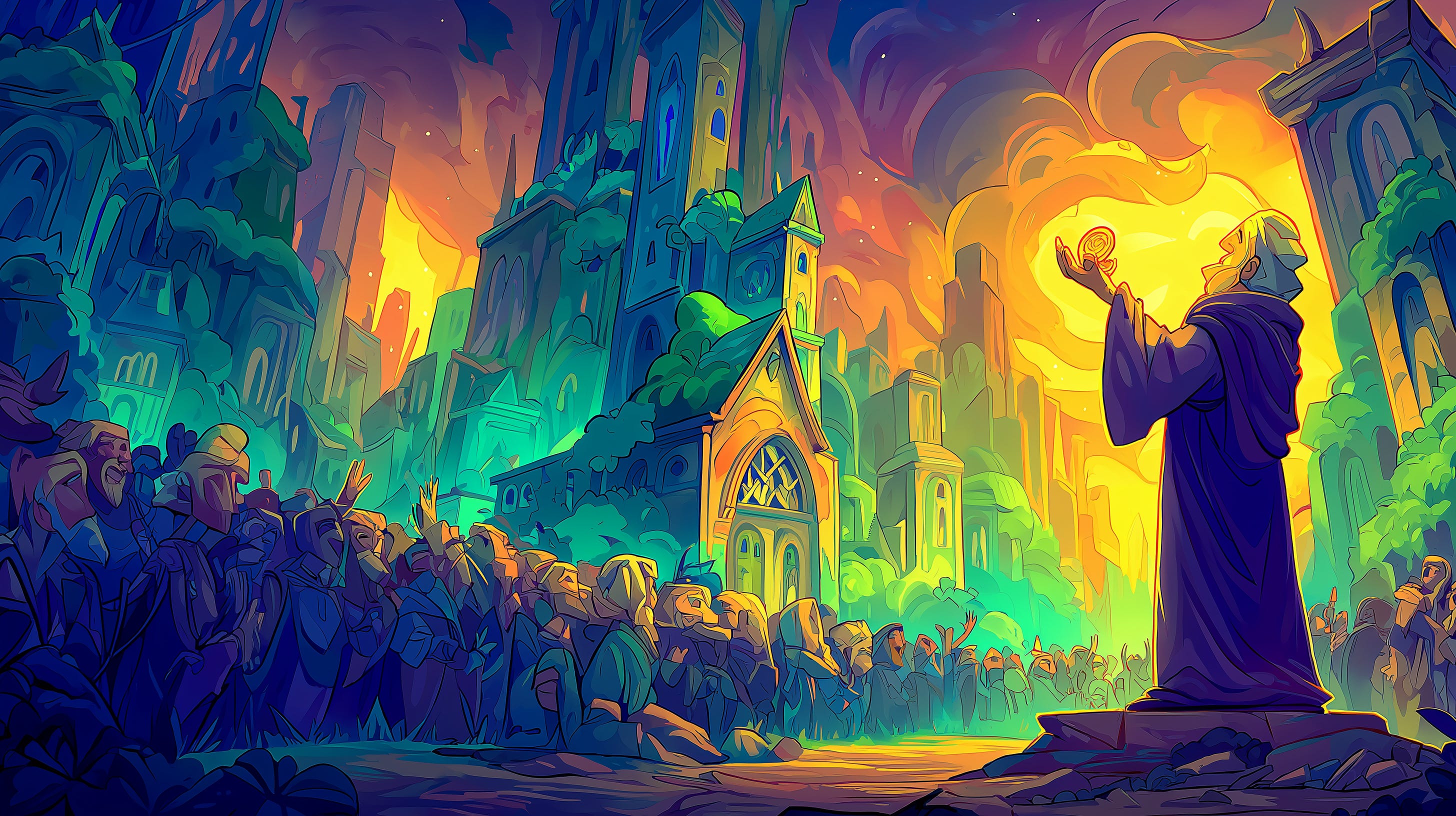
“Friends,” The Wolf’s voice was different, tight with adrenaline. “Look at the ruins around us. Look at the skeletons of the towers that elevated umano to the sky. You wonder how the ancestors built such miracles? You think they were giants? No. They were just like us. But they possessed a secret magicka.”
He flipped the coin. It rang against the silence, a sharp, metallic sound that made my skin crawl.
“They didn’t just work,” he whispered, and the crowd leaned in, hooked. “They earned. They understood that time is not a gift to your neighbor, but a debt to be collected. With this,” he held the coin high, “you do not need to ask for help; you can command it. The Ancestors climbed to the stars because they learned how to stack these higher than their shelters.”
I looked at the crowd. I didn’t see disgust the likes of what I was feeling. I saw a terrifying, dawning hunger. They were starving for a delight they hadn’t even tasted yet.
I climbed up onto a food preparation bench at the edge of the piazza and called out to the crowd.
“Peoples of the land, please hear me!” Eduardo, the wolf looked across the piazza and glared at me.
“I have made some important new discoveries. We must ignore these emblems of the past. These towers, those coins,” I gestured at the shiny metal disc in Eduardo’s hand. “They are the vain projects of our ancestors’ destruction! Just this morning I have deciphered a final warning from the past in their archives, hidden within the code as if placed fearfully. The people who conveyed this message were terrified, and so too should we be”.
Eduardio scoffed audibly. His face carved into a wry grin.
“Old friend, only you have attempted to understand that arcane nonsense you call ‘code’. What then does this magic nonsense language, that only you claim to understand, tell you?”
The crowd shuffled nervously at the exchange, but I hadn’t lost their ears just yet.
“It tells of hunger,” I stammered, my voice sounding thin in the open air. “The archives speak of a great entity called ‘The Economy.’ It was a demi-go, not of flesh or spirit. It was a machine. It lived through numbers. An entity designed to accelerate heat and consumption.”
I held up my data slate, waving the glowing blue text at them. To me, it was clear proof. To them, it was just flickering light.
“The ancients did not die by accident,” I shouted, desperation causing my throat to stutter. “This god, this ‘Avaris’, calculated that Umano was going to die anyway. So it gave us this to accelerate it!” I pointed a trembling finger at the coin in Eduardio’s hand. “It gave us the illusion of scarcity. It turned our cooperation into competition. It made them burn their own world just to see the numbers on their parchments go up. It is a suicide pact disguised as progress!”
The silence that followed was heavy. I looked from face to face, hoping to see a spark of recognition, a shadow of fear.
I saw only confusion.
Eduardio did not yell. He did not argue. He simply stepped forward, his boots crunching loudly on the gravel. He held the coin up to the sun again.
“He speaks of invisible gods,” Eduardio said, his voice calm and melodic. “He speaks of ancient ghosts and suicide pacts written in a language only he can read. I speak of this.”
He tossed the coin to a young woman in the front row, Saraginia, a weaver. She caught it, surprised by the weight.
“That is power, Sara,” Eduardio said softly. “That is a new roof. That is food for your children without begging the commune.”
Sara looked at the gold disc. Then she looked at me. In her eyes, the abstract terror of a machine god evaporated. It was replaced by the very real, very warm comfort of security. She closed her hand around the coin.
“But it’s a trick!” I cried, stepping down from the bench. “Don’t you see? Once you start counting, you never stop. The hunger never ends!”
“Enough,” someone shouted from the back.
“Let The Wolf speak,” another voice joined in.
The mood shifted. I was no longer a friend warning them of danger. The collective warmth of the Storico was gone, replaced instantly by the cold calculation of individual gain. Eduardio had not just introduced money, he had introduced the fear of losing it.
Eduardio smiled at me. It was a pitying look. “Step down, brother. The future is waiting.”
I retreated. I had to. The glint in their eyes told me that I had lost.
***
I waited until the moon rose to find him.
I found him sitting on the edge of the old viaduct, his legs dangling over the ruins of the city below. He was counting a stack of gold coins, the metallic clink-clink-clink the only sound in the night.
“You look tired,” he said without turning around.
“You are unleashing a plague,” I said, sitting beside him. I kept my distance. The air around him felt charged, electric with ambition. “I translated the final log, Eduardio. The Economy wasn’t a tool. It was a weapon system. It targeted the ego. It destroyed the biosphere of this planet in two hundred years. We are barely recovering.”
Eduardio stopped counting. He looked at the stack of gold, watching the moonlight play across the relief of a long-dead emperor.
“And look at what they built before they died,” he whispered, gesturing to the skeletal skyscrapers jutting out of the jungle below. “They touched the sky. We play in the mud. We survive, yes. But do we live?”
“We are happy,” I countered. “We are at peace.”
“We are stagnant,” he snapped. He turned to me, and the Wolf was fully present in his face. “I read your translation, old friend. I know about Avaris. I know the Machine God wanted us to burn out.”
I froze. “You knew? And you still did this?”
“I agree with Avaris. Better to burn bright than to rot in the dark,” he said. He picked up a coin and flicked it over the edge. We watched it fall, a tiny spark tumbling into the abyss. “Perhaps the machine was right. Perhaps humans are designed to burn. Why fight our nature? We will build towers again. We will have armies. We will have art and music and power.”
“And then we will die,” I said. “We will eat the world and leave nothing for the children.”
Eduardio stood up, dusting off his dark trousers. He looked like a giant against the stars.
“Then we will leave them a glorious ruin,” he said. “Go home, brother. There is no place for a Storico in the Order of Growth. We have no use for history. We only care about the future.”
He walked away, back toward the village.
I stayed on the viaduct for a long time. Down in the valley, the first fires of industry were being lit. I could smell the smoke. It didn’t smell like warmth. It smelled like an engine starting up, a deep, mechanical rumble that would not stop until it had consumed everything.
The Machine God had been patient. It had waited three thousand years in the dark since the collapse. And tonight, with a single coin, it had reclaimed its throne.
From the Cartographer’s Desk
I wrote this story because I’m haunted by Eduardio’s choice. It’s easy to call him the villain, and I wholeheartedly disagree with him, but is he wrong?
I’d love to hear your take in the comments:
The World Question: Eduardio argues that it’s better to burn bright and leave a glorious ruin than to live in stagnant peace. Is survival enough, or do humans need the fire of ambition, even if it eventually consumes us?
The Craft Question: I tried to treat economics not as a concept, but as a biological virus. For my fellow writers, how do you approach turning abstract concepts (like time, love, or money) into physical threats in your fiction?
A Small Request: If this story sparked a thought for you, please Save this post (click the little bookmark icon at the top or bottom). It signals to the Substack algorithm that this map is worth keeping, and it helps new readers find their way to the Atlas.
Until the next coordinate,
Graeme