


Moving from the discovery of discovery writing.
I announced three weeks ago that I was about to embark on a bold new rewrite of my Substack serial, ‘The Strings of Us’. I wrote about the reasoning behind the changes in my previous article, the Kintsugi Rewrite, which goes into depth explaining why I felt now was the right time to abandon my short tenure as a discovery writer (the act of writing straight ahead without the guardrails of an already pre-quantified plot) and become a plotter once more. You can read about that whole thought process below. 👇
The dawn of a kintsugi rewrite

Over the last year and a bit, I have written 14 chapters of The Strings of Us. I poured my heart into them. I love the prose, I love the deep lore of the Chrysaora, and I deeply love the characters of Elias, Cas’shya, Lysander, and Hec’ten.
How is the plotting coming along?
Well, now that you ask, rather well, thank you.
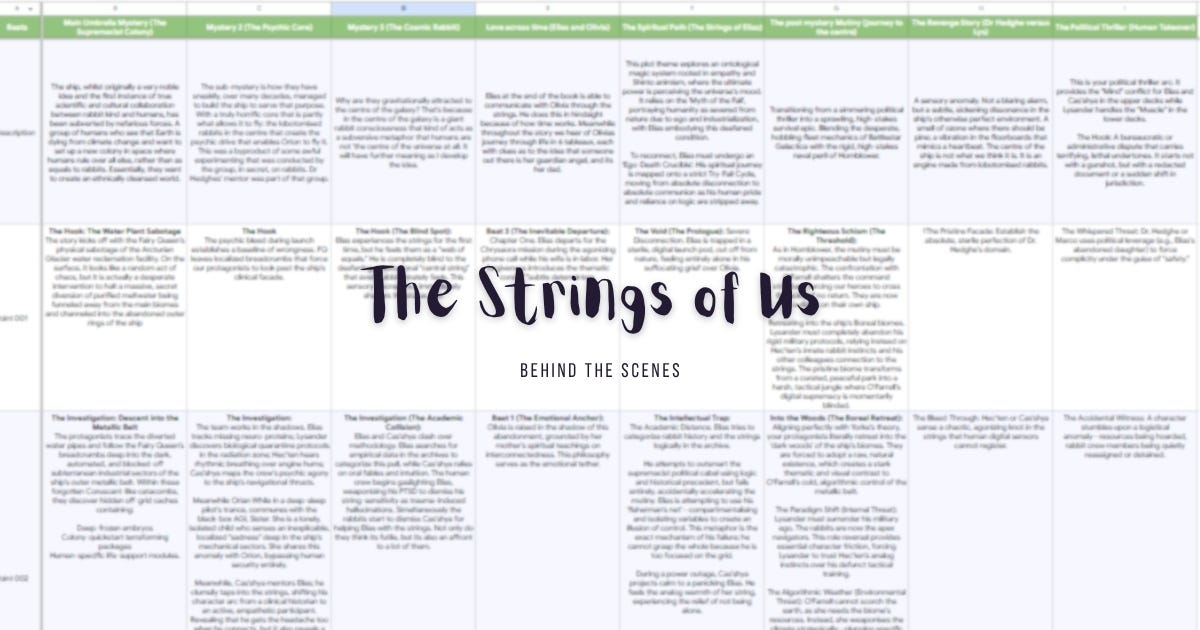
Plotting for me is familiar territory, and so thankfully returning to it to decipher the many strands of intrigue I have woven into the story so far has been a really fun and joyful process. The first task has been to simply identify what those core strands are. Do I have a love story on my hands? Perhaps a beguiling mystery? I have set about keeping it as simple as possible: writing out the thesis behind each story thread in a column of my plotting spreadsheet, then identifying the type or genre of story I am dealing with. Not character arcs, nor an arbitrary attempt to write out the whole story beat by beat in bullet point form chronologically. No, the purpose here is simply to understand exactly what types of stories I am trying to tell.
But Graeme, isn’t the genre of the story sci-fi?
Sci-fi is one of those rare types of genre that contains within it the seeds of many others. Like a Russian nesting doll, you will never see a sci-fi that doesn’t have various other types of stories resting inside its very broad walls. Take, for example, ‘The Martian’ by Andy Weir, which is a survival thriller wrapped up as sci-fi. Or the first instalment of ‘The Expanse’ by James S. A. Corey, which is a detective noir mystery dressed in the clothes of sci-fi.
Similarly, ‘The Strings of Us’ hides within its speculative sci-fi world a multitude of genres that need to be unpacked.
We have:
Three different mystery plotlines. A political mystery, a soft horror mystery, and a metaphysical mystery.
A revenge plotline.
A nostos plotline (where a character goes on a long journey and has to find their way back home).
An enlightenment plotline (where a character achieves a level of spiritual understanding that sets them apart from their peers).
A mutiny plotline. One of my favourite types of storylines.
And this is just the start. I still have a number of threads still to pick out from the tapestry and put a name to. It is an exciting feeling.
Why do you need to know the story trope for each thread?
One of the really big challenges I was starting to confront with discovery writing ‘The Strings of Us’ was that the more I wrote, the more I realised that there was a lot more going on here than a simple journey to the centre of the galaxy story with rabbits.
The format of the story would not be able to serve these various threads without buckling under its own weight. This has become a multi-cast, multi-threaded story, similar to a show like Downton Abbey. Single-POV chapters in which characters exist in their own siloed plotlines would inevitably fail to deliver this larger vision.
With that understanding, I need to know that when I attempt to deliver any of these tropes, I do so in a way that aligns at least somewhat with the expectations of those tropes inherent in the reader.
A mystery story, for example, has a certain set of beats that people have intuitively come to expect. An instigating moment. An investigation. Pushback from the powers behind the mystery. Red herrings to throw the main character and the reader off the scent of the solution. And of course, an eventual satisfying answer to the mystery that is both surprising and logical.
You can map these core beats onto almost every great mystery story of note, from Poirot to Tintin and even Scooby-Doo.
The current status of the plotting work.
So this, dear friends, is where I am currently. Deeply embedded in a spreadsheet that identifies the different tropes inside my sprawling cosy sci-fi. It has been a huge amount of fun so far. I have been able to map out parts of the story that had so far been mere feelings. I have manoeuvred characters into new roles that have been both surprising and yet completely sensible (if also heartbreaking at times when a character turns out to be a lot worse than you thought). It has involved a lot of research into these various threads, re-reading some of the writing bibles of our time, such as ‘Save the Cat’, ‘The Hero with a Thousand Faces’, or ‘Into the Woods’.
But most importantly of all, I feel extremely positive that the groundwork and foundations I carved into those early chapters have real potential to tell a story that genuinely excites me, and that I hope will excite you too.
Embracing the Messy Reality
Writing a novel while balancing a 45-hour corporate workweek is an exercise in endurance. Smashing up tens of thousands of words to start over feels like walking backwards up a mountain.
But this is the messy reality of draft writing. I don’t want to just give you a polished final product; I want you in the engine room with me, grease on our hands, figuring out how this massive generation ship actually flies. The story, just from these thoughts, is already breathing differently. It feels dangerous, tactile, and alive.
Support the Unseen Work
Rebuilding a universe takes time, wine, music, and a lot of late nights staring at digital whiteboards. If you value this kind of upfront transparency and want to back the messy, unglamorous process of independent storytelling, consider stepping into the Cartographer’s Guild. Your paid subscription directly funds the hours required to wrestle this epic into its truest form.
Join the cartographers’ guild and help this ship fly.
Alternatively, drop something in the Ko-Fi. It all goes towards eventually turning this complex speculation into a finished product. All with your help. I will be updating this shop in due course with products related both to The Strings of Us and the wider Atlas I am building here, so stay tuned.
Thank you for being here for the bumps in the road. The Chrysaora is preparing for launch, and the new Chapter One is going to be a tad more explosive.
Love 💖🐇🦕
It's a weird feeling. I think because I spent so much time with this story discovery writing it first, I don't feel that caged. There have been moments when I've been plotting out the story and character arcs, and every now and again my note has been... Just write it and see. I think I've learnt to trust now when I can discover it as part of the process.
I guess the biggest thing it has done for me so far (aside from filling in a few gaps that I hadn't figured out yet) is that when I was discovery writing it felt like I was trying to hold the entire novel in my head, and now it feels more like I can focus on one section at a time knowing the basic goals, and giving myself (and the characters) permission to get me there while I write.
I'm also completely open to the writing to open up new angles now. My favourite thing about discovery writing was the surprise when you suddenly opened up a new door that was exciting and different, but that still served the bigger plot.
So I guess now I would say, I'm going for a hybrid approach. Less like a cage, and more like a map with permission to get lost on the journey.
This post reads like horror to me 😂
I have, at some point, tried what I'd call "plotting light", aka writing an outline in very compressed prose form, because it gives me anxiety to think of my story in bullet points. Turns out, my characters don't like me plotting either. They've strayed from the script at the first possible turn and I don't think there's much of a way back 😅
Still, it's very interesting to see your process here. And I feel like with complex plots such as yours it does make a lot of sense to track what's going on in a spreadsheet, especially if you actually enjoy that part haha. But do you never feel caged when things are so rigidly outlined already?