


Sarah - Herculaneum - early 79AD - Cassius, a 14 year old boy, son of a tavern owner, who dreams of one day setting sail on the open seas.
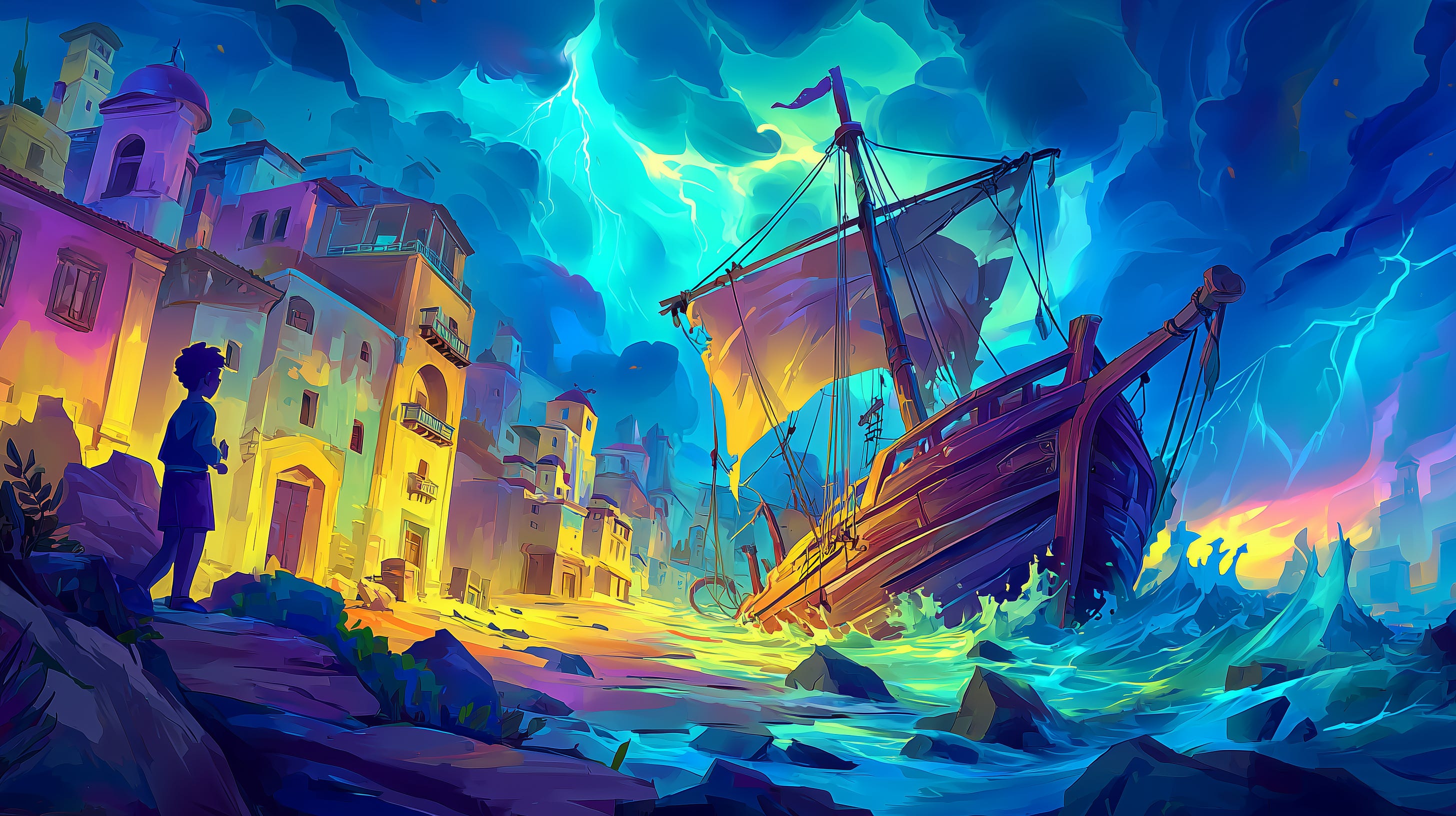
The Aurora Archives: Day 17
ARCHIVE ENTRY: 0016-HERC LOCATION: Herculaneum, The Bay of Naples DATE: February 79 AD (The Month of Parentalia) SUBJECT: The two-hearted swimmer & The Redemption of Marcus TRANSLATOR: Cas’shya (Archive Administrator)
PART I: The Wax Tablets of Marcus
(Recovered from the sediment of the ancient shoreline. The writing is heavy, pressed deep into the wax by a hand shaking with rage and fear.)
IV Non. Feb. The boy is gone again. He leaves before the sun hits the tavern floor. When he returns, his skin is cold, and his hair is stiff with salt. I asked him where he goes. He looked at his feet and said, “Nowhere, Papa.”
He has his mother’s eyes. They are terrible at lying. I smell the ocean on him with its saline tang. It makes my chest tight everytime I catch it on the air. It smells like the night the Fortuna went down off the coast of Trinacria. I can still hear the wood screaming. I can still feel the water filling my lungs as the armour tried to drag me down. I promised the Gods that if I lived, my bloodline would never touch the sea again. I am trying to save him. Why does he fight me?
Prid. Non. Feb. Old Aetnaeus came into the tavern today for wine. He laughed, slapping the counter. He told me a tall tale from his fishing boat. He swore by Jupiter that he saw a seal playing in the cove near the cliffs.
“But it wasn’t a seal, Marcus,” he said. “It had long ears. And a boy was swimming with it. Holding onto it like a brother. They dove deep, Marcus. Deeper than any sponge diver could. It was unnatural.” The tavern laughed. I did not. I knew.
Ides Feb. I followed him. I climbed down the goat path to the hidden cove. I saw them. My boy was in the water. And the beast was there. A brown rabbit, but it moved strangely, missing a back foot. A cripple. But in the water... I watched them. The boy held the beast against his chest like a floating log. They took a breath together. Then, they sank, plummeting down into the water as if they were made of lead. They moved along the bottom, graceful, twisting through the kelp and around the rocks like a fish. Then, they shot upward, breaking the surface in a spray of joy. It was beautiful. And it terrified me. The terror took me. The flashbacks locked in my mind, the water, the drowning men, the darkness. I saw my son dead. I screamed. I waded into the surf, boots and all. I grabbed Cassius by the hair. The beast tried to nip me, to protect him. I struck it. God help me, I struck the crippled creature. I kicked it hard. It squealed, a sound like a child, and scrambled into the rocks and out of sight. “If I see it again,” I roared, “I will kill it!” I dragged Cassius home. He did not speak. He did not cry. He just looked into dead space, numb, as if I were the monster. I am doing this for him. I am protecting him.
PART II: The Oral History of Sal’acia
(Transcribed by Cas’shya. This account was preserved in our oral histories through song, and cross-referenced with local folklore.)
NARRATOR (Cas’shya): The history of the rabbit known to the locals as Sal’acia, is one of loyalty, betrayal, and redemption. The story tells us that Sal’acia was alone. She had lost her primary drive-leg to a fisherman’s crab trap. On land, she was vulnerable, unable to generate the torque to hop or defend herself.
But then came the boy.
The boy did not eat her. The boy brought her grasses, fruits, and leaves. The boy saw that Sal’acia was heavy on her feet, heavier than she looked. But when he saw her in the water, she was transformed. In the water, she used her heart string to become like the fish and could dance between the waves like a dolphin. The boy watched at first, but soon wanted to join in. He held Sal’acia close. When Sal’acia made herself heavy, they sank past the turbulent waves, down to the quiet sand and the corals. When Sal’acia made herself light, they rose and could even get up enough speed to leap above the surface. The boy provided the fins; Sal’acia provided the ballast. They were a single engine. A symbiosis and they played this way for months.
Then came the angry man. The blow hurt. Sal’acia hid in a crevice in the cliffs, shivering, ribs bruised, perhaps even broken. She waited for the boy. Waited two days in the hope that he might return, but the man had dragged the boy away angrily. Hope seemed lost that she would see her friend again. The hunger came, but she stayed, just a few more days longer, the loyalty was strong.
The third night a storm that seemed to contain the fury of Neptune blew in.
The ocean turned into a mouth of white teeth. The noise was deafening. Sal’acia saw the boy running down the beach. The boy was crying, calling her.
“CUNICULUS!” He called, over and over.
Sal’acia did not care about the pain in her ribs. She hobbled out. The boy seeing her amongst the rocks scooped her up, burying his face in Sal’acia’s fur. “I’m sorry,” the boy sobbed. “I’m sorry.” Sal’acia responded in kind.
“Sorry too, for fathers anger.”
The boys surprise was immediate, but there was no time for it. A ship had shattered on the reef beyond the bay. People were screaming in the foam. The boy looked at the water as it frothed. The sky was painted nearly black and the wind whipped at the waters surface like a carpenters plane. It was death. No human could swim it. But maybe together they could. The boy looked at Sal’acia. Sal’acia thumped her chest. Ready. They ran into the waves.
It was hard. The current wanted to smash them against every rock. But when the waves rose to crush them, Sal’acia increased her gravity downwards, anchoring them to the sandy floor, letting the water roll over their heads. Then, in the lull, they shot forward. They reached the first survivor, a sailor. They dragged him back to the bay outside of the town.
On the shore, the angry man, the father, was screaming. But when he saw the boy drag the sailor onto the sand, the screaming stopped. The father looked at the sailor coughing up water. He looked at the storm. Something broke inside him. He ran into the water, not to stop them, though for a moment the boy and Sal’Acia both feared it, but to join them instead.
They worked together. The father, the son, and the rabbit The father was strong, but he was afraid. Sal’acia could feel the fear vibrating in the water. But the father did not stop. It was as if something stronger than fear gripped him, propelled him. He pulled people from the surf, his face wet with tears and spray.
Then came the last push. The storm was it its peak. The father was tired. The cold had gotten into his blood. He was treading water, pushing against a heavy plank in the water. Sal’acia and the boy saw him struggling. They turned to help. But a wave tore a woman and her child from the wreckage nearby. They were drifting out. The father saw them. The babys cries echoed above the roar of the water. He looked at the boy. He looked at Sal’acia. He did not wave for help. He pointed at the woman. He shouted a word the ocean tried to swallow:
“Go!”
It was the hardest calculation Sal’acia ever made. The gravity of the situation was absolute. They obeyed. They saved the woman and the child.
When they returned for the father, he was floating face down in the shallows, bobbing like a piece of wood in the still turbulent water. They pulled him onto the black sand. The boy pressed on his chest. Sal’acia pressed her warm body against the man’s cold side. For a moment they believed it could work. The father opened his eyes one last time. The fear was gone in them. The anger was gone too. He whispered to the Boy.
“I was afraid... But I am not anymore. My only fear… I was the anchor... holding you down. Dont live by my example. Be free. Swim.” He looked at Sal’acia. A look of respect. “Take him,” the Father whispered. “Take him to the horizon. Do not let him stay here.”
He died with the salt on his lips, they were smiling. That night, the boy did not go back to the tavern. He boarded the sister ship to the one that had wrecked, a rare survivor in the storms aftermath. He took Sal’acia. They sailed at dawn with a captain enamoured by their already legendary deeds. They left the grief on the shore, and they took the love with them into the deep.
Archivist’s Note
ARCHIVIST: Cas’shya SYSTEM NOTE: The rabbit locals of Herculaneum spoke of this event for years. They called it “The ocean bond”, and shared the story of Sal’acia for centuries until it seemed to lose all context and became a myth until the recent discovery of the wax tablets at Herculaneum corroborated it. This story illustrates a critical function of our ancestors: Emotional Catalyzation. The rabbit applied its skill with the strings to bond with the human child. By becoming heavy, it allowed the boy to dive. By becoming light, it allowed him to rescue. But the true weight that was lifted that day was not the sailors in the water. It was the fear in the father’s heart. The ‘Christmas Spirit’ here is found in that final gesture: A father realizing that loving his son meant letting him be free of his own trauma, even if it cost him his life.
To see the whole series. Click the link below. 👇
