


Over the last year and a bit, I have written 14 chapters of The Strings of Us. I poured my heart into them. I love the prose, I love the deep lore of the Chrysaora, and I deeply love the characters of Elias, Cas’shya, Lysander, and Hec’ten.
But this past week, after a long look at the story so far with my developmental editor (AKA me), I realised a hard truth: I have to drop it from a great height, let it smash into shards, and rebuild it, Kintsugi style.
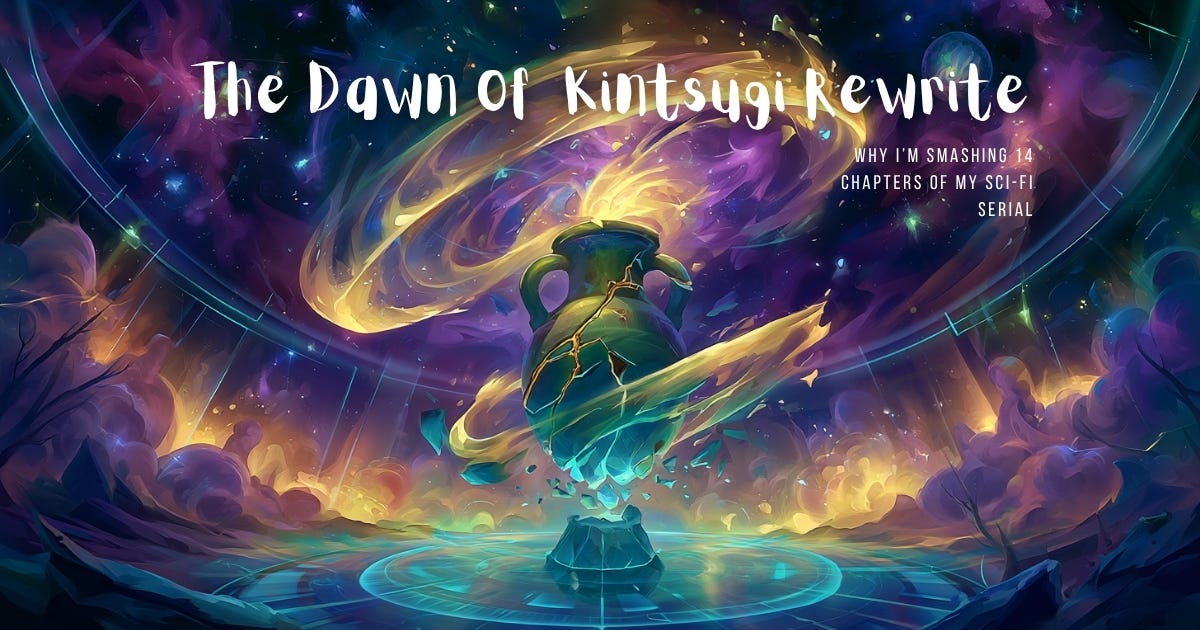
If you are a writer, you might empathise with that sinking feeling in your belly when you realise a structural overhaul is necessary. If you are a reader, you might be wondering why an author would deliberately drop and smash up a story they already love.
The honest answer? I have tried a new approach to writing this story since its conception, pantsing (the act of writing page by page without much of a plan), and while I have gained much from this process, a side effect has occurred. Something I have spoken about before. The sticky sickness that is the ‘world builders’ pox’.
The Problem:
When you build a universe as complex as this one, where intelligent rabbits navigate the cosmos via gravitational strings, and human political factions are hiding dark secrets inside a generation ship. And all the while, the author is commenting on facets of eastern spiritual philosophy, it is tempting to want to explain everything.
In my current draft, I have been isolating my characters in unique point of view (POV) chapters. I had a beautiful prologue about mythical history. I have a chapter where Elias and Cas’shya sit in a pristine holographic archive, politely debating the ancient fable of Philoc the Swift. Meanwhile, chapters later, Lysander and Hec’ten were hunting a saboteur known as the Fairy Queen. It is all incredibly siloed.
The chapters worked beautifully in isolation, but together? The pacing was jarring. My characters were trapped in separate bubbles, waiting for the plot to happen to them. I was prioritising the lore of my universe over the forward momentum of the people living inside it.
The Battlestar Blueprint
Naturally, I looked to some of my favourite examples of serial writing to fix this; in particular, I had to look at masterful ensemble storytelling. Enter on-stage, Battlestar Galactica, Avatar: The Legend of Aang, and Downton Abbey.
The shining brilliance of these narratives is that they don’t give characters isolated episodes to just sit and think. They trap their vast ensembles in the exact same pressure cooker - all together. This is the same whether it is a high-stakes episode, or more of a filler episode where the cast go on a jape. Whether you are a lord, a cook, a pilot, or a president, you are reacting to the same immediate crisis, episode by episode.
So, I am taking a sledgehammer to my idea of having singular POV’s. At least for the first act.
Instead of letting Elias and Cas’shya debate history in a vacuum, we will be opening Act one with an explosion. The Fairy Queen is sabotaging the Arcturian Water Reclamation plant right as Lysander and Hec’ten are touring it.
The shockwave of that explosion is going to ripple through the ship, knock out the power grid in the holographic archive, and trigger a devastating PTSD flashback for Elias, who is still grieving. Suddenly, Cas’shya breaking rabbit taboo to comfort him isn’t just a sweet, passive moment; it is a heartening act of empathy in the dark of a momentarily malfunctioning ship.
And when Lysander barges into their archive moments later, holding a piece of physical evidence he can’t decode, the storylines finally cross-pollinate. The ancient history Elias and Cas’shya study is no longer a textbook; it is the literal blueprint the saboteur is using to bypass the ship’s AI.
Embracing the Messy Reality
Writing a novel while balancing a 45-hour corporate workweek is an exercise in endurance. Smashing up tens of thousands of words to start over feels like walking backwards up a mountain.
But this is the messy reality of draft writing. I don’t want to just give you a polished final product; I want you in the engine room with me, grease on our hands, figuring out how this massive generation ship actually flies. The story, just from these thoughts, is already breathing differently. It feels dangerous, tactile, and alive.
Support the Unseen Work
Rebuilding a universe takes time, wine, music, and a lot of late nights staring at digital whiteboards. If you value this kind of upfront transparency and want to back the messy, unglamorous process of independent storytelling, consider stepping into the Cartographer’s Guild. Your paid subscription directly funds the hours required to wrestle this epic into its truest form.
Alternatively, drop something in the Ko-Fi. It all goes towards eventually turning this complex speculation into a finished product. All with your help. I will be updating this shop in due course with products related both to The Strings of Us and the wider Atlas I am building here, so stay tuned.
Thank you for being here for the bumps in the road. The Chrysaora is preparing for launch, and the new Chapter One is going to be a tad more explosive.
Love 💖🐇🦕
Thanks for sharing your thoughts and process. I've gone through a lot of rewrites in my life, so I know how dire it can feel to dunk all of the previous work into the trashcan. But it's been worth it every single time!
A quick question though: Does that mean it'll be better for me to wait on the revised version to get into the strings of us? When will you likely start posting? 👀